Animal Questions.org

Everything You Ever Wanted to Know About Animals

How Big Are Basking Sharks Mouths?

The mouth of a basking shark is almost certainly its most recogizable feature. In fact, when they have their mouths closed, basking sharks are often mistake for great whites due to similarities in their body size and structure.

Just take a look at that mouth!

But just how big is the mouth of a basking shark, and why?

Before we get to the size of the mouth, we should talk about the overall size of the basking shark. This will give you some idea of not only the sheer size of the mouth, but also how big it is compared to the body of the shark.

Often reaching sizes of 20-26 feet in length and weighing over 5 tons, basking sharks are actually the second largest fish in the world, closely behind the whale shark.

With all that being said, let’s get to the mouth!

The mouth of an adult basking shark can get to approximately 1 meter (3.3 feet) wide.

That’s big enough to swallow most people whole! Fortunately, that will never be a concern because basking sharks are filter feeders which feed exclusively on small things floating in the water such as plankton, very small fish, and even fish eggs.

In fact, this is precisely the reason that the basking shark’s mouth is so large. It needs as much water as possible to be flowing through the gill rakers in its mouth, to collect enough food for the shark to survive. An adult basking shark can process over 1500 gallons on water per hour.

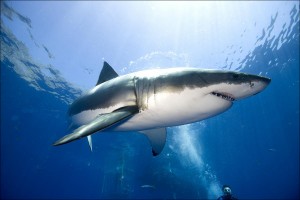
Do Sharks Lay Eggs?

There are approximately 400 different species of sharks, of these 400 species about 40% of them lay eggs. All sharks mate through internal fertilization, during which the male shark inserts one or both of his claspers into the female’s reproductive tract and deposits his sperm. The mother may then either lay the fertilized eggs, or they might develop partially or fully inside of her. The young sharks get their nourishment from a yolk sac or through other methods.

Egg Laying Sharks

When a shark’s eggs are laid, they are in a protective egg case. These egg cases have tendrils, which allow them to attach to substrate such as corals, seaweed, etc. Sometimes these cases will wash ashore on the beach. In some species of sharks the egg cases are pushed to the bottom of the ocean or into crevices between and/or underneath rocks.

In oviparous shark species (egg laying), the young sharks get their nourishment from a yolk sac. These young sharks may take several months to hatch. In certain species of sharks, the eggs stay inside the female shark for a period of time before they are laid, this allows the sharks to develop fully and spend less time in the immobile egg cases before they hatch.

Types Of Sharks That Lay Eggs

Just a few species of sharks that lay eggs include:

  • Bamboo sharks or carpet sharks
  • Swell sharks
  • Cat sharks
  • Horn (bullhead) sharks

Live Bearing Sharks

The other 60% of shark species give birth to live young, rather than lay eggs. This is known as viviparity. In these species of sharks, the young remain in the mother’s uterus until they are born.

Do Sharks Have Tongues?

Although they are much different from the tongues that humans possess, it is true that sharks do have tongues. However a shark’s tongue is not called a “tongue”. Instead it is called basihyals. The basihyal is located on the floor of the shark’s mouth and is basically nothing more than a small, stout that has a vague tongue like piece of cartilage. In most sharks the basihyal is relatively immovable this in turn generally makes it useless. However in other species of sharks their basihyal is larger, more flattened, moveable, and often used to efficiently suck up prey.

Can Sharks Swim Backwards?

Although sharks are streamlined swimmers and ferocious predators in the water, they lack the ability to swim backwards and the ability to stop swimming suddenly. This is due to the fact that a shark’s pectoral fins cannot bend upwards like a fish can. This limits their swimming ability to a forward motion. Thus, if a shark needs to move backwards, it uses gravity to fall. In order for a shark to come to an abrupt stop they must swerve to the side in order to hit something as they cannot just simply stop themselves. For the shark swimming for them is more like flying.

Some sharks are fast swimmers that can swim anywhere up to 40 miles per hour. The great white shark swims by propelling itself through the water using its tail. Their fins are only used for balance. Other sharks such as the whale shark, move their bodies from side to side to propel themse lves through the water. If sharks do not keep swimming they will sink. The reasoning for this being that unlike other fish they are not equipped with a gas filled bladder to help keep them afloat. Their large, oily liver provides some buoyancy but even so, they are still heavier than the water and will sink unless they propel themselves through the water properly.

Are Sharks Afraid Of Dolphins?

Sharks are not necessarily afraid of dolphins. Nor are dolphins often found killing or attacking sharks. There have been a few instances where a dolphin has taken on a shark that is relatively small in order to defend itself. Rumor has it that the myth that sharks are afraid of dolphins may have come from an incident that took place at a seaquarium in the 1950’s when a sandbar shark showed too much interest in the birth of a Bottlenose Dolphin calf, and as a result three of the adult male dolphins ganged up on the shark, butting it in the gills and stomach until it finally died.

During the 1960’s the United States Navy also trained Bottlenose Dolphins to incapacitate large sharks by butting them in their gill pouches. The dolphins quickly learned to attack certain species of sharks such as the Sandbar shark or the Lemon shark but still seemed to be afraid to try and take on a Bull shark. It should be noted that bull sharks are about the same size and shape as the dolphins and that in the wild the Sandbar and Lemon sharks are not typically found to attack dolphins, whereas the Bull shark has been found to attack the dolphins in the wild. This suggests that dolphins may be able to sense which types of sharks pose a threat and which do not.

For the most part sharks and dolphins leave each other alone. However, Some 75% of wild dolphins show some degree of shark scarring, and we usually only see the ones who were fortunate or strong enough to get away.

Can Sharks Live in Fresh Water?

For most shark species, spending a day in fresh water would be similar to placing us humans on the moon without a spacesuit. They most likely would not be able to survive due to the inhospitable surrounding environment. One of the main problems that would pose a serious threat to sharks in this case is the process known as osmosis. Osmosis refers to when a fluid moves through a semi-permeable membrane from a solution with a low solute concentration to a solution with a higher solute concentration until there is an equal concentration of liquid on both sides of the membrane. In this case, the dissolved substances involve sodium and chloride.

Because sharks evolved in salt water, they are equipped with salty bodies. Even sharks in fresh water contain more than twice the amount of salt and chloride as other fish that are more common among freshwater. In theory, sharks that are placed here should burst like a balloon when it is overfilled with air, given the osmosis effect; however since they urinate a lot they are able to avoid this problem.

The sharks take in a lot of extra water however they excrete much of it as urine that is diluted and has a rate of over 20 times that of typical saltwater sharks. What this means is that their kidneys are required to work harder than normal, thus utilizing additional energy. Much like humans that have become accustomed to life in low oxygen regions, sharks in fresh water appear to adapt to what would seem to be formidable conditions.

Although there have been several studies over the years that have determined that there are in fact some species of sharks residing in freshwater environments, relatively few sharks spend a substantial amount of time here. In fact, river shark populations are now at dangerous lows. Bull shark’s population numbers are higher since they often move between fresh water and salt water environments. Other species of sharks however, that are more adapted to life in lakes and rivers are faced with having to withstand both natural and human induced problems within their habitats. Problems that these sharks face include changes in temperature, oxygen, mineral content, and other climate changes. Human activities such as damn building, water modifications such as irrigation and the introduction of pollutants to the water all pose a serious threat to these particular species of shark.

Are Sharks Mammals Or Fish?

Sharks are not mammals. Rather, they are a species of fish because they have a skeleton that is entirely composed of cartilage and is equipped with tough, leathery, scale less skin. These skeletons differ greatly from those of the bony fish or other terrestrial vertebrates. Cartilage is flexible, durable and has about half the amount of density as bones. As a result this helps to reduce the skeleton’s weight and conserves energy. Sharks also lack a rib cage which would result in its own weight crushing it if it were placed on land. Sharks do not have lungs that breathe air; they breathe oxygen by passing water over their gills. These creatures have highly streamlined bodies.

The earliest known shark dates as far back as 420 million years ago. Since that time, sharks have diversified into 440 different species ranging in size and length. A shark’s teeth are embedded in the gums rather than directly affixed to the jaw and are constantly replaced throughout its life. The jaw’s surface and its gill arches need extra support due to its heavy exposure to physical stress and its need for strength.

shark

In sharks, the respiration and circulation process takes place when deoxygenated blood travels to the creature’s two chambered heart and then pumps blood to the gills via the ventral aorta artery where it branches into afferent brachial arteries. Reoxygenation takes place in the gills and the reoxygenated blood flows into the efferent brachial arteries which come together to form the dorsal aorta. The blow flows from this aorta throughout the body. The deoxygenated blood then flows through the posterior cardinal veins to enter the posterior cardinal sinuses. It is here that the blood then enters the heart ventricle then causing the cycle to repeat.

Unlike mammals which are warm blooded creatures, most sharks are cold blooded meaning that their internal body temperature matches that of their ambient environment. Another thing that makes sharks differ from other mammalian species is the way in which they digest their food. A shark has an extremely short intestine. This short length of the intestine is achieved by the spiral valve with multiple turns within a single short section instead of a long tube like intestine that many mammals possess. The valves provide a long surface area that requires food to circulate inside the shark’s short gut until it has been fully digested, when remaining waste products pass into the cloaca.

shark

Most sharks are ovoviviparous, meaning that their eggs hatch in the oviduct within the mother’s body and that the egg’s yolk and fluids secreted by glands in the walls of the oviduct help nourish the embryos. The young continue to be nourished this way until they hatch. Differing from sharks, mammals give birth to live young and feed them with milk from their mammary glands. There have also been two cases where sharks have reproduced asexually; another difference compared to mammals as mammals are now the only major group of vertebrates in which asexual reproduction has not yet been observed.

Ask a Question

Latest Questions

  • Do Sea Horses Hibernate?
  • Do Beavers Use Echolocation?
  • Are Salmon Bottom Feeders?
  • Do Bats Produce Poisonous Venom?
  • Is a Penguin a Bird, Mammal or Amphibian?
  • Can Cats Really Hear Ultrasound?
  • Are Axolotls Nocturnal?
  • Where Are Axolotls Found?
  • Do Stingrays Have Teeth?
  • Are Axolotls Good Pets to Own?

List of Animals

  • Aardvarks
  • Alligators
  • Armadillos
  • Axolotls
  • Basking Sharks
  • Bass
  • Bats
  • Bears
  • Beavers
  • Bees
  • Cats
  • Chickens
  • Chipmunks
  • Cod
  • Coyotes
  • Crabs
  • Crocodiles
  • Dogs
  • Dolphins
  • Elephants
  • Ferrets
  • Fish
  • Foxes
  • Frogs
  • General
  • Giraffes
  • Hawks
  • Hermit Crabs
  • Iguanas
  • Jellyfish
  • Lizards
  • Mammals
  • Mudpuppies
  • Newts
  • Ostriches
  • Owls
  • Pandas
  • Parrots
  • Penguins
  • Porcupines
  • Rabbits
  • red pandas
  • Reptiles
  • Salamanders
  • Salmon
  • Seahorses
  • Sharks
  • Silverfish
  • Snails
  • Snakes
  • Snapping Turtles
  • Spiders
  • Swordfish
  • Toads
  • Trout
  • Turtles
  • Uncategorized
  • Woodpeckers
  • Zebras

Copyright © 2016 - AnimalQuestions.org